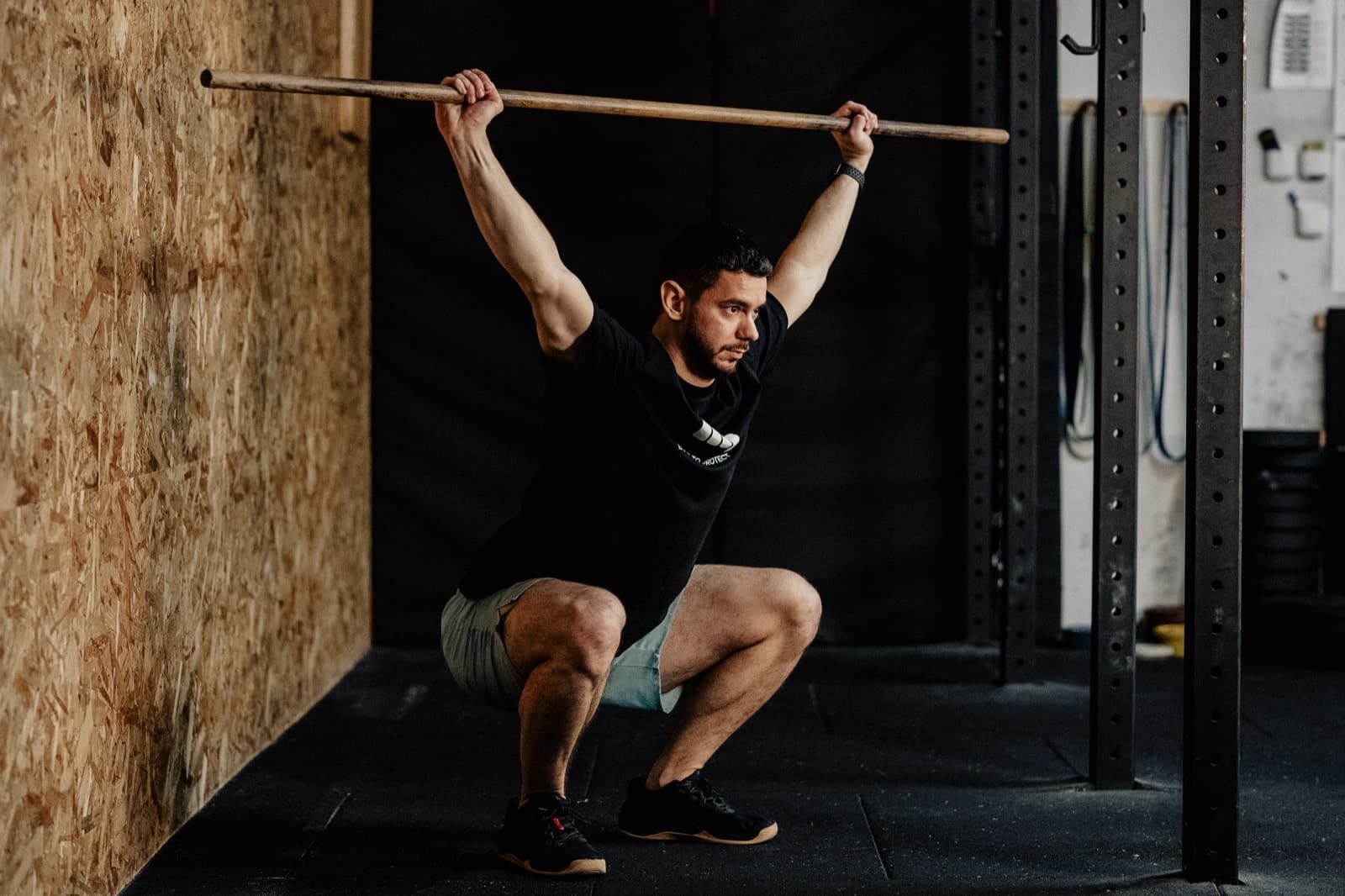
Prehab: what it is, its benefits and how to fit it into your training
Years of intense training leave their mark: a shoulder that pulls overhead, a stiff ankle in the squat, a sore wrist in the front rack. We tend to wait until something locks up before dealing with it. Prehab flips the problem around: you work ahead of time, before compensations set in.
What is prehab?
Prehab (short for "prehabilitation") is the proactive counterpart to rehab. Where rehab steps in once a problem is established, prehab strengthens, ahead of time, the areas your training loads the most: shoulders, wrists, core, hips, ankles.
In practice, it's not about lifting heavier or adding volume. Prehab focuses on stability, motor control and strength through the full range of motion: targeted exercises, often light, performed with precision.
At Deep, this approach has a method: structural strength. It gives prehab a clear direction, starting from your own deficit areas rather than a list of generic exercises.
What is the goal of prehab?
The goal is simple: build a structure that can handle your training. Muscles, tendons and joint control get stronger where you lack range or stability, so your sessions rest on a solid base.
Prehab doesn't replace your training, it makes it more sustainable. Fewer compensations, more consistency: continuity is what drives progress, far more than one heroic session followed by three weeks off.

5 benefits of prehab
- 1
Fewer compensations. A weak area pushes the body to cheat elsewhere. By strengthening it, you spread the load more evenly across your joints.
- 2
More continuity. Fewer recurring niggles means sessions that string together and progress that doesn't reset to zero.
- 3
Usable range of motion. Gaining mobility isn't enough: prehab builds strength and control within that range, right where you need it.
- 4
Better technical carry-over. Stable shoulders overhead, solid wrists in the front rack, mobile ankles in the squat: your technical movements benefit directly.
- 5
More even progress. By filling in your deficit areas, you stop plateauing on the same movements.
Which areas should prehab target?

Shoulder
Key to overhead movements and gymnastics. Rotator cuff work, like the banded shoulder external rotation, builds its stability.

Wrist
Heavily loaded in the front rack, handstands and push-ups. Pronation and supination work, like the banded wrist pronation, builds its tolerance to load.

Core
It transfers force between the upper and lower body. The abdominal vacuum targets the transversus abdominis, the deepest layer of the abdominal wall.

Hip
Its rotational mobility shapes the quality of your squats and lunges. The 90/90 hip external rotation works that range.

Ankle
A stiff ankle limits squat depth and makes the knee compensate. The banded ankle eversion strengthens the muscles that stabilise it.
When should you do prehab?
Prehab doesn't need a session of its own. It belongs in your regular training, ideally on the days you train: before the session, to activate the areas about to work, or after, to make the most of a body that's already warm.
Avoid pushing it to your rest days. This work takes intention, and a rest day should stay a rest day. Ten to fifteen minutes, three to four times a week, is enough to lay the foundations.
How to get started with prehab in 5 steps
- 1
Identify your deficit areas. Mobility, stability, motor control: assess each area, with a dedicated assessment or a movement professional.
- 2
Pick 3 to 5 targeted exercises, prioritising your weakest areas.
- 3
Place them before or after your sessions, three to four times a week.
- 4
Progress step by step: range and control first, then load or time under tension.
- 5
Reassess regularly, every four to six weeks, to adjust the work as you evolve.
The first step matters most. A generic prehab programme misses the mark, because it doesn't account for what you actually lack.
Good to know
Prehab or rehab?
Prehab works ahead of time, on a pain-free body. If you have persistent pain or an injury, see a healthcare professional: that's when supervised rehab takes over.
Key takeaway
Prehab is the work you do before you need it. Targeted at your deficit areas, it builds a stronger structure, fewer compensations and a practice that lasts. Structural strength is Deep's method for giving it a clear direction.
Want to know where to start your prehab?
Take the prehab assessment